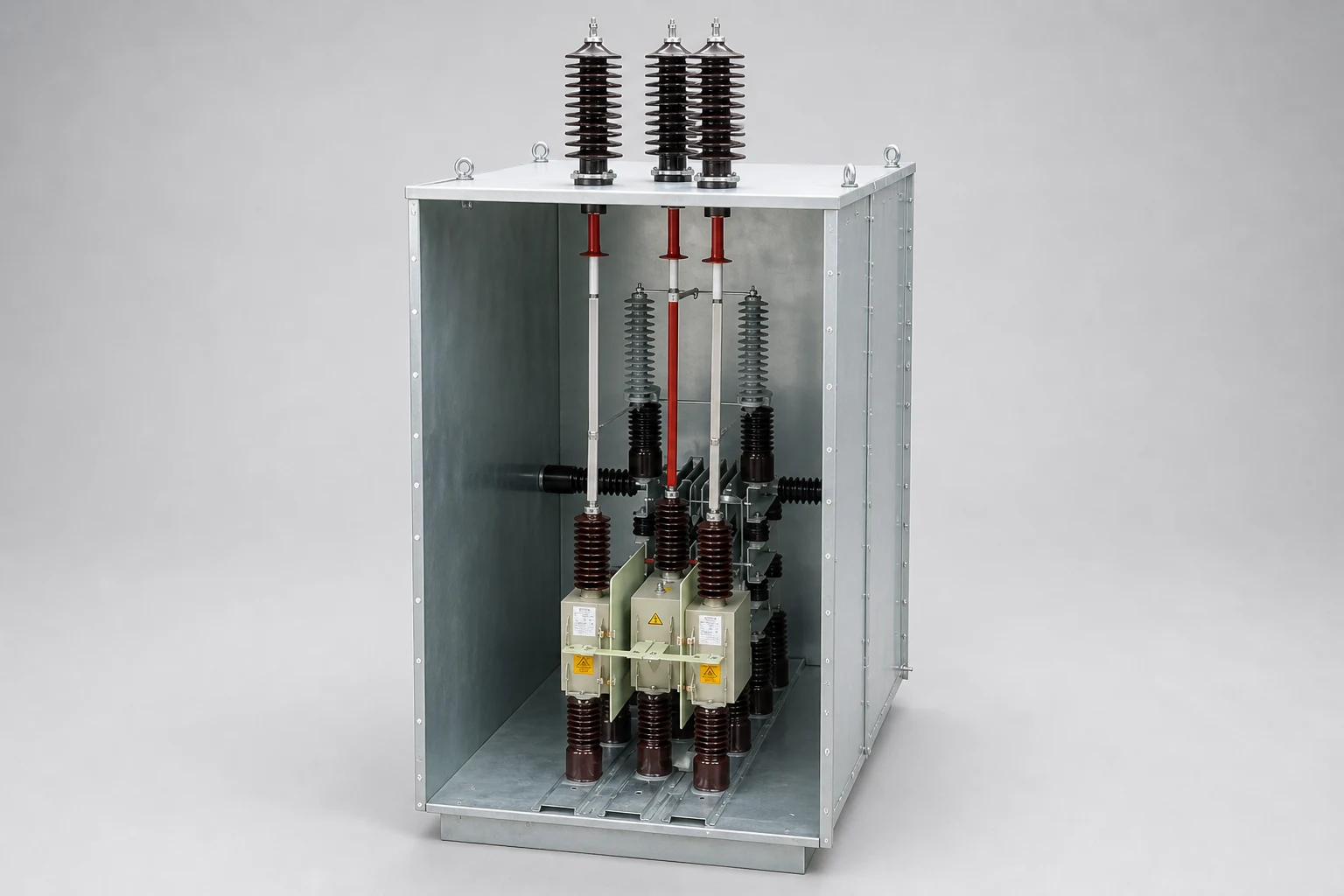
Hilkar Metal Enclosed RC Snubber Filters protect generators, reactors, motors, and transformers against insulation damage caused by switching transients and high-frequency overvoltages. Without adequate transient protection, these overvoltages can lead to winding insulation failures, costly repairs, and unplanned downtime.
During circuit breaker or contactor switching, the sudden interruption of current flowing through inductive loads can generate high transient overvoltages. Hilkar RC Snubber Filters act as high-frequency surge suppressors, limiting these transients before they reach critical equipment.
Designed primarily for shunt reactors and other inductive loads, Metal Enclosed RC Snubber Filters protect equipment from steep wave-fronts, high-magnitude voltage spikes, surges, switching transients, and temporary overvoltages. By limiting voltage overshoot and effectively damping oscillations, they improve equipment reliability and extend insulation life.
- Reduce maintenance costs by minimizing downtime and repairs
- Improve operational reliability and production continuity
- Superior protection against inter-turn insulation failures
- Extend the service life of motors, transformers, generators, and reactors
- Reduce the risk of circuit breaker pre-strike, restrike, and re-ignition
- Limit transient voltage magnitude, dv/dt, and the rate of rise of recovery voltage (RRRV)
- Easy installation and commissioning
- Power Generation Plants
- Pulp and Paper Industry
- Petrochemical Industry
- Chemical Processing Plants
- Surface and Underground Mining
- Water and Oil Pumping Stations
- Railway Systems
- Large Motor Applications
- Arc Furnaces
- Industrial facilities using motors, transformers, or reactors
- Protection against high surge peaks and steep-front transient voltages
- Withstands motor impulse voltage levels recommended by CIGRE and IEEE
- Suppresses and damps pre-strike and restrike switching transients
- Eliminates voltage doubling by matching cable terminating impedance and reducing surge reflections
- Suppresses current reflection phenomena and higher harmonic current zeros during circuit breaker switching
- Operating voltage up to 36 kV
- Compact all-in-one design with R, C, and LA components integrated in a single enclosure
- Impulse withstand voltage up to 200 kV BIL
- Surge capacitance ratings from 0.1–2 µF, depending on site requirements and application
- Surge resistance ratings from 1–200 Ω, depending on site requirements and application
- Factory assembled, fully tested, and ready for installation
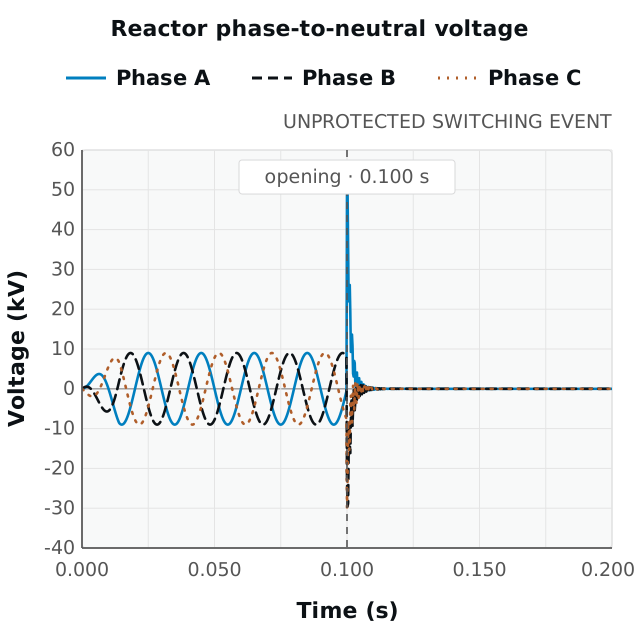
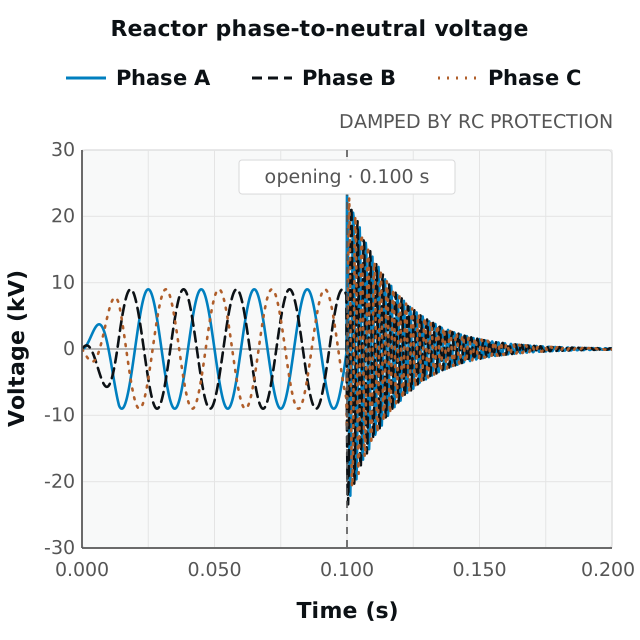
The comparison below illustrates the performance of a network without protection (CASE-A) and with an RC Snubber Filter and Surge Arrester (CASE-B). The protected configuration effectively reduces the peak value and steepness of transient overvoltages, ensuring that voltage stresses remain within the equipment's specified insulation withstand limits and improving overall system reliability.
Hilkar RC Snubber Filters are custom-designed for 1 kV to 36 kV, single-phase or three-phase 50/60 Hz systems. They are primarily used to protect industrial motors, transformers, reactors, and generators.
Single-phase and three-phase configurations are available to meet specific application requirements. Each RC Snubber combines capacitors, resistors, and surge arresters to suppress transient overvoltages and damp switching oscillations.
Depending on the application, Hilkar RC Snubber Filters should be installed as follows:
- Install in the protected equipment's terminal box or associated switch panel, connected between each phase and ground.
- Connect to the equipment terminals using a minimum 3 × 25/16 mm² cable and the supplied accessories.
- Ground the RC Snubber to the motor, transformer, or circuit breaker earth connection.
- When porcelain bushings are used, connect them with flexible leads to prevent damage caused by shock or vibration during transportation and operation.
- Do not tighten the fixing nuts beyond 20 Nm.
- Flexible leads may be shortened but must not be extended, and should be connected directly to the protected equipment terminals.