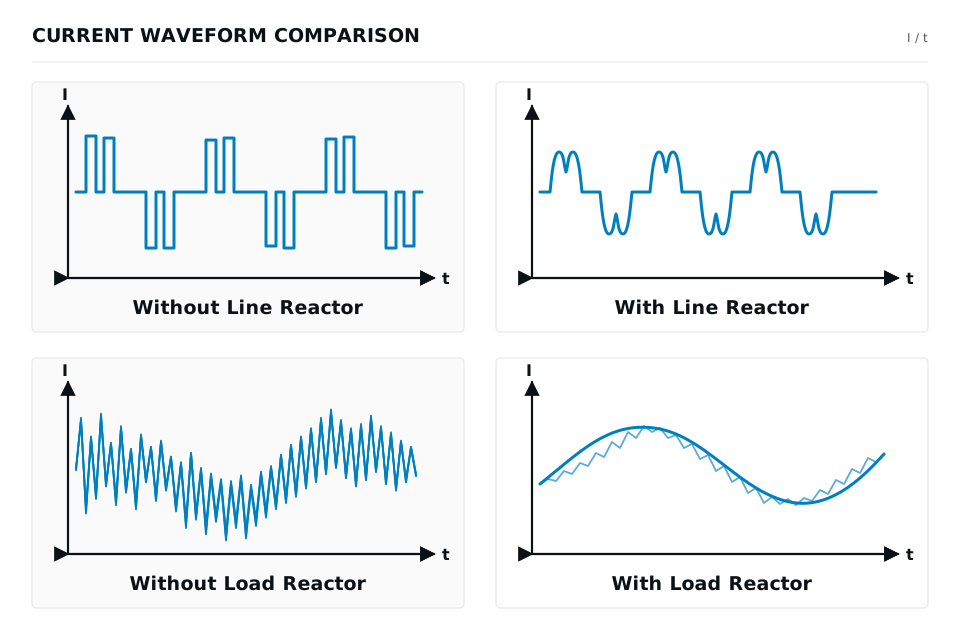
Line and Load Reactors are connected in series with the input and/or output of three-phase power electronic equipment such as variable frequency drives (VFDs), inverters, UPS systems, and motor controllers. They are designed to reduce the harmful effects of harmonics, switching transients, and high dv/dt generated by semiconductor switching devices such as IGBTs, thyristors, and diodes.
By limiting current transients and filtering electrical disturbances, Line and Load Reactors improve power quality, enhance equipment reliability, and extend the service life of motors and power electronic systems. Typical benefits include:
- Reduced starting current
- Lower harmonic distortion
- Reduced voltage rate of rise (dv/dt) and switching-induced voltage stress
- Lower motor heating and operating temperature
- Reduced motor acoustic noise
- Simplified fuse selection based on rated motor current
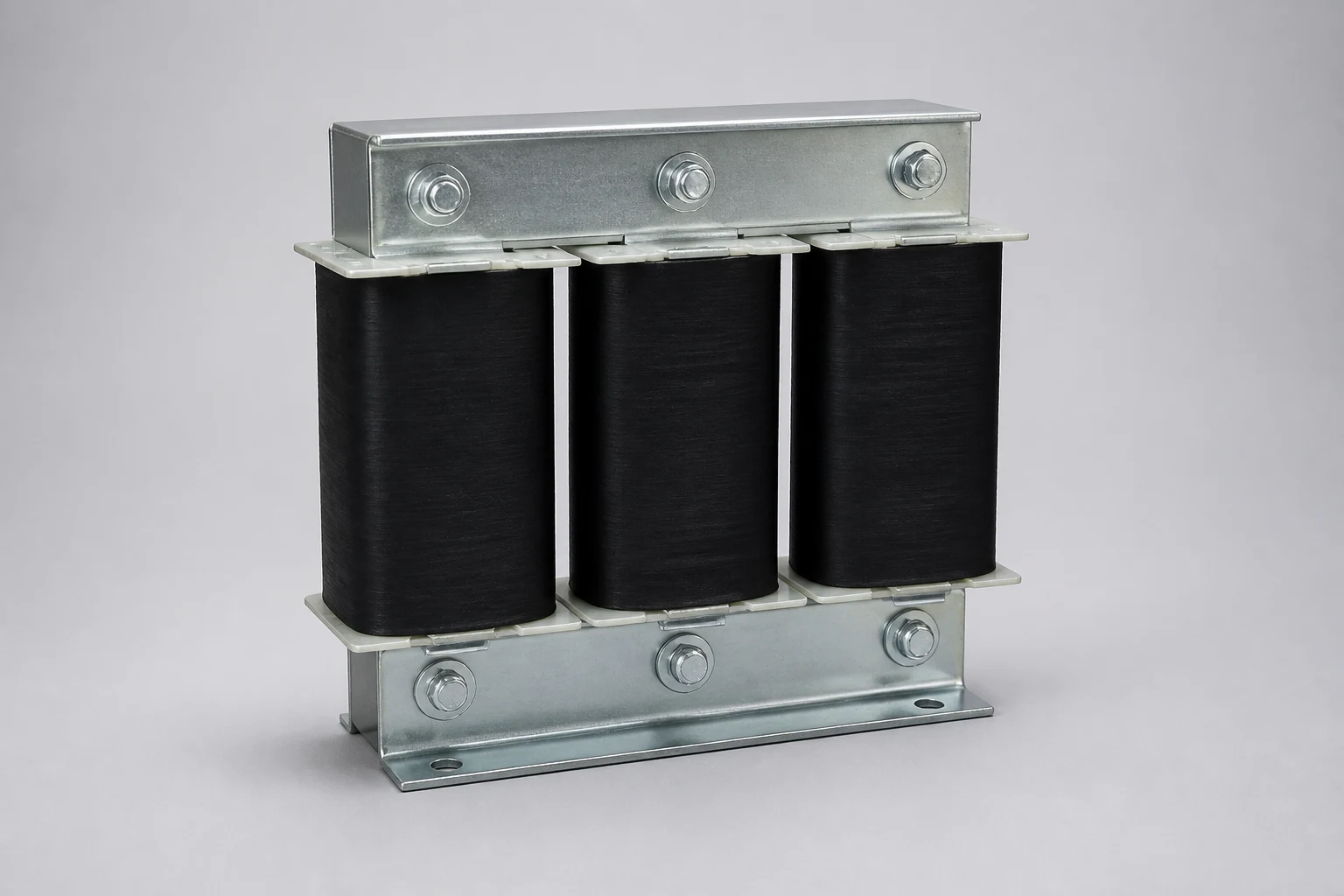
Hilkar reactors are typically designed for a 4% voltage drop, with other impedance values available upon request. Each reactor is custom-engineered according to the application requirements, considering voltage, current, inductance, harmonic content, transient conditions, thermal performance, and installation constraints.
All reactors are manufactured and routinely tested in accordance with IEC 60076-6 or other applicable standards. Available tests include:
- Designed and tested in accordance with applicable IEC and IEEE standards
- High quality factor (Q) for optimum performance
- High thermal capacity for continuous operation
- High mechanical strength to withstand severe short-circuit forces
- Fiberglass resin spacers for enhanced cooling efficiency
- Compact design with dimensions customized to project requirements
- Flexible installation in side-by-side, delta, or vertical arrangements
- High-quality insulation varnish and corrosion-resistant surface coating
- Aluminium, hot-dip galvanized steel, or concrete support structures available upon request
- Voltage
208–690 V
- Rated Current
In, 50–60 Hz*
- Overload Capability
Imax = 2I1 for 12s, 1.5I1 for 60s, 1.1In continuous
- Linear Current
Ilin = 1.6I1
- Impedance Levels (Z)
1.5%, 2%, 3%, 4%, and 5%
- Type
Iron Core
- Maximum Altitude
≤1000m*
- Installation
Indoor
- Insulation Class
F
155 °C
- Winding Material
Aluminum or Copper
- Protection Degree
IP00
Indoor
- Temperature Range
−40 °C … 55 °C
- Thermostat
125°C
- Insulation Level
3kV AC
For 1 min
- Cooling
AN
Air Natural
- Options
Taps with DIN or NEMA terminal configuration
*Consult Hilkar for higher ratings
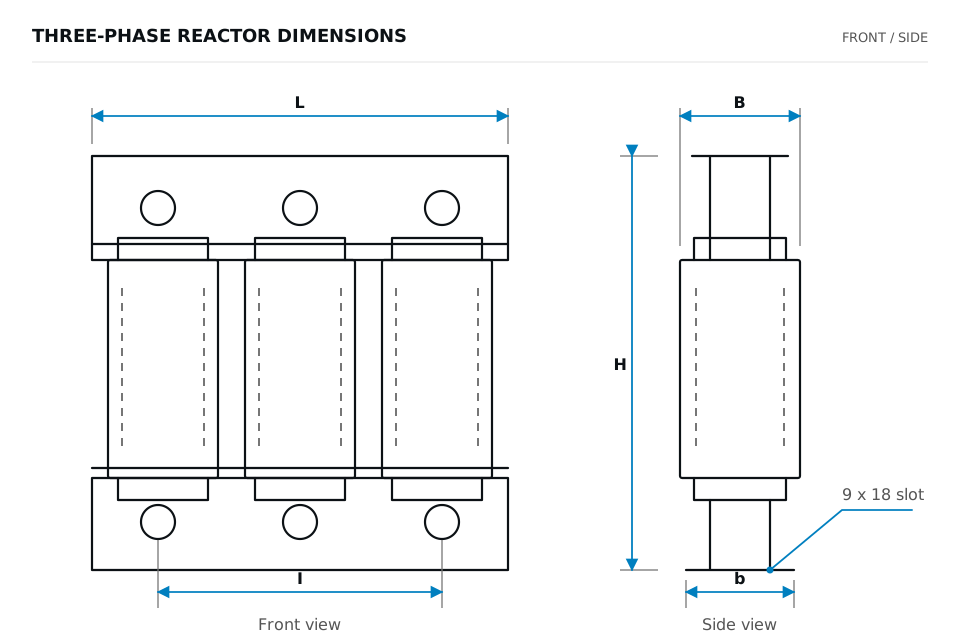
| Type | In(A) | L ±5 % @ Ilin(mH) | PM(kW) | ΔP(W) | m(kg) | mm | ||||
|---|---|---|---|---|---|---|---|---|---|---|
| L | I | B | H | b | ||||||
| MR5 | 10 | 2.93 | 4 | 31 | 2.1 | 180 | 120 | 72 | 170 | 72 |
| MR5 | 16 | 1.83 | 7.5 | 43 | 3.8 | 180 | 120 | 72 | 170 | 72 |
| MR10 | 20 | 1.47 | 10 | 45 | 3.8 | 180 | 120 | 78 | 170 | 78 |
| MR10 | 25 | 1.17 | 11 | 52 | 3.8 | 180 | 120 | 78 | 170 | 78 |
| MR10 | 35 | 0.84 | 15 | 54 | 6.5 | 180 | 120 | 78 | 170 | 78 |
| MR15 | 40 | 0.73 | 18.5 | 60 | 6.5 | 240 | 160 | 105 | 207 | 94 |
| MR15 | 50 | 0.59 | 22 | 65 | 13.5 | 240 | 160 | 105 | 207 | 94 |
| MR20 | 63 | 0.47 | 30 | 75 | 13.5 | 250 | 160 | 105 | 207 | 105 |
| MR25 | 80 | 0.37 | 37 | 86 | 18 | 250 | 160 | 105 | 207 | 105 |
| MR30 | 100 | 0.29 | 45 | 86 | 18 | 250 | 160 | 122 | 207 | 114 |
| MR40 | 125 | 0.23 | 55 | 90 | 23 | 300 | 200 | 130 | 260 | 120 |
| MR50 | 160 | 0.18 | 75 | 100 | 23 | 300 | 200 | 130 | 260 | 125 |
| MR50 | 200 | 0.15 | 90 | 107 | 26 | 300 | 200 | 140 | 260 | 135 |
| MR60 | 250 | 0.15 | 112 | 131 | 52 | 300 | 200 | 156 | 260 | 150 |
| MSR10 | 320 | 0.125 | 150 | 166 | 52 | 300 | 200 | 156 | 260 | 150 |
| MSR10 | 320 | 0.0175 | 187 | 160 | 68 | 300 | 200 | 156 | 260 | 150 |
| MSR10 | 400 | 0.060 | 225 | 145 | 50 | 300 | 200 | 156 | 260 | 150 |
| MSR10 | 500 | 0.050 | 262 | 145 | 69 | 430 | 290 | 156 | 260 | 150 |
Hilkar performs all routine tests in accordance with IEC 60076-6 or other customer-specified standards. Complete test results are provided to the customer, and type test reports are available upon request. The standard testing program may include:
- Routine Tests (Inductance, DC Resistance, AC Withstand Voltage, and Lightning Impulse Withstand)
- Short-Circuit Withstand Test
- Temperature Rise Test
- Sound Level Test
- Seismic (Earthquake) Test